

We Are Here
Yesterday, I sat in a Denver theater and listened as a cast of actors with disabilities sang three simple words: We are here. I had gone to see 504: The Musical, presented by Phamaly Theatre Company in partnership with the Denver Center for the Performing Arts. I expected to be entertained and to learn something. What I didn’t expect was how deeply the story would reach into me. Because I am here, too.
In 1973, Congress passed the Rehabilitation Act. Tucked inside was Section 504, a groundbreaking civil rights provision declaring that people with disabilities could not be excluded from, denied the benefits of, or discriminated against by programs receiving federal financial assistance simply because they had a disability. These were important, historic words.
However, four years later, the regulations needed to enforce Section 504 still had not been signed. So, people with disabilities did something about it. In April 1977, demonstrations took place across the country. In San Francisco, more than 100 disabled activists and their allies occupied a federal building.
They stayed for 25 days.
Think about that. People who used wheelchairs. People who were blind. People who were deaf. People with physical, intellectual, and other disabilities. People who needed attendants, medications, food, communication access, and one another.
They stayed. They demanded that the government do more than promise equality. They demanded that the government act. And at last they succeeded. The Section 504 regulations were finally signed on April 28, 1977.
And where was I while all of this was happening?
I was in college. In 1973, when the Rehabilitation Act was passed, and again in 1977, when people with disabilities were demanding that Section 504 be enforced, I was attending William Woods University and later Pittsburg State University.
I had no idea any of this was happening.
I certainly knew discrimination. While applying to college, many schools would not accept me or give me a chance because I was blind. I knew what it felt like to have someone else decide what I could or could not do based upon my disability. Yet, I didn’t know that somewhere else in this country, people with disabilities were fighting a battle that would help shape my future.
Sitting in the theater nearly fifty years later, watching their story unfold, I couldn’t help wondering: How could something so important to my own life have been happening while I knew nothing about it?
Perhaps that’s one reason the play touched me so deeply.
Our story as disabled people is being told on a Denver stage through 504: The Musical. Phamaly brings this history alive through music, humor, conflict, relationships, and characters who remind us that the disability community has never been one voice or one experience.
We don’t all think alike. We don’t all move alike. We don’t all communicate alike. We don’t even necessarily agree about what disability means. Yet, we are here.
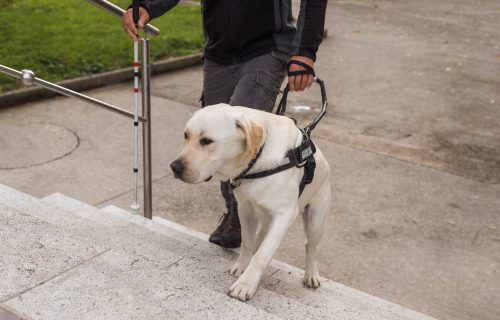
For me, sitting in that theater as a blind woman, the story wasn’t simply history. It was personal. I thought about the accessibility I use every day, the education I received, the career I built, the stages I’ve stood upon, the technology that allows me to write these words, and the freedom to move through my community with my Seeing Eye dog, Ava.
None of those freedoms simply appeared.
People fought. People protested. People refused to go away. Some fought battles before I even knew there was a battle to fight. That realization humbled me and reminded me that civil rights are not something we achieve once, put on a shelf, dust off occasionally, and admire.
They require attention.
Today, Section 504 remains federal law. No state has abolished it. However, its protections continue to face legal challenges. A lawsuit that originally involved 17 states caused alarm throughout the disability community. The challenge has changed considerably since then. As of today, three states—Alaska, Florida, and Texas—remain actively challenging regulations concerning the right of people with disabilities to receive services in integrated community settings rather than being unnecessarily institutionalized.
Why should that matter to someone who doesn’t have a disability?
Because disability isn’t somebody else’s world. It is part of the human experience. A child may be born with a disability. An athlete may acquire one tomorrow. Someone you love may need accommodations you never imagined thinking about. Or someday, that person may be you.
Section 504 helped establish a simple principle: disability should not determine whether someone gets to participate.
That principle matters, and that is why 504: The Musical matters. It isn’t simply telling us what happened in 1977. It is asking us what we will do in 2026.
The Denver production continues through August 23 at the Denver Center for the Performing Arts. Go for the music. Go for the history. Go for the laughter. Go to meet people whose lives may look different from yours. And perhaps, as I did, you will leave thinking about three little words.
We are here.
Years ago, I came across a poster filled with butterflies of different colors, shapes, and sizes. Across the bottom were the words: “Diversity creates dimension in our world.”
I’ve never forgotten them.
Think about a world filled with butterflies that were all the same size, shape, and color. Something would be missing.
So it is with humanity.
We need people who move differently. People who see differently. People who hear differently. People who communicate differently. People who learn differently. People who experience this world differently.
Our differences don’t diminish our world. They give it dimension.
We were here when the Rehabilitation Act was passed in 1973. We were here when protesters occupied a federal building in 1977. We were here when the Americans with Disabilities Act became law in 1990. We are here in 2026. And we will be here tomorrow.
We are artists, teachers, parents, leaders, workers, writers, musicians, dreamers, neighbors, and friends.
We are not invisible! We are not an afterthought. We are part of the magnificent diversity of humanity.
We have something to contribute, to teach, and to sing!
Perhaps those performers on the stage weren’t simply singing about disability history. Perhaps they were asking all of us to see one another differently.
Because we have always been here, and still, we are here.
When we finally recognize that truth, we change the way we see—and change the way we live.
Add A Comment