
Trust Your Dog
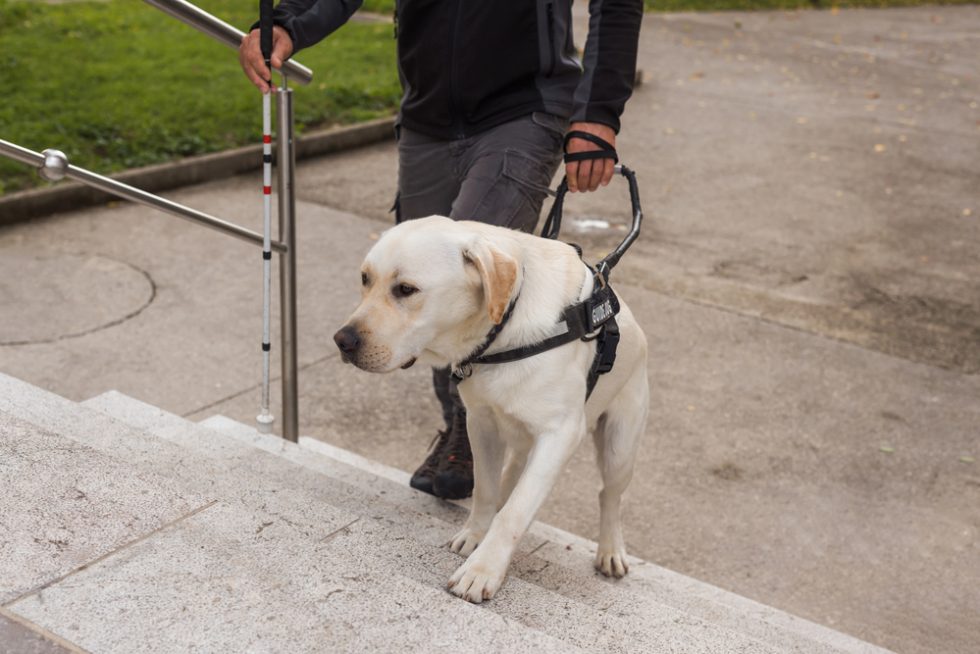
Every time I’ve gone to Morristown, New Jersey, to the Seeing Eye school for training, I could almost hear every trainer that I’ve met along my forty-eight-year journey say, “Trust your dog.” Yep, trust your dog.
I was reminded of this phrase again this past week when I was on a walk. My guide dog, Miss Ava, and I were crossing the final block before reaching my apartment building. I’ve been consulting with the folks from the City of Englewood, making sure they were putting sturdy fences across the sidewalks and streets for their upcoming two-month construction project in front of my building.
I didn’t want another mishap like the one four years ago when Ava went through the construction cones. That day, I didn’t hear any people working and thought she was walking perfectly across the street. Well, the cones were five feet apart—just enough for us to glide through. She did fine; however, about half-way across I found my right foot up to my calf through the asphalt.
So, now on this day—previously asking them for a more secure barrier–I heard the noise from the large construction trucks a block away.
“Trust your dog.”
We kept walking. The noise became deafening. At the corner, with noise blasting my ears, we stopped. I asked Ava to turn left; however, she refused.
“Trust your dog.”
I didn’t understand. I couldn’t see why. That old intelligent disobedience training was working just fine. Then I realized my job at that moment wasn’t to understand; my job was to trust the dog who could see what I couldn’t. She couldn’t turn left because there was a fence blocking her way. “Good girl.” I stood there listening and wondering how to proceed.
Do I trust her and forge ahead?
Do I turn around and go back the way we came?
Do I ask for assistance?
Standing, listening, assessing, thinking, I pondered my next steps. Knowing I could do all of these things. And there were possibilities to consider; I thought I’d try asking for help. If this didn’t work, I’d go to my next option. So, I unfolded my five-foot-long telescopic cane—which I brought for this purpose—and waved it above my head. Maybe someone would see us. Wave. Wave. Wave. Yes? No? Wave.
Eventually, a woman came by. “Do you need help? There’s a big truck in your way. Your dog can get around it. Let me walk in front of you and show her.”
I said, “Yes, thank you,” and she guided us around and through where the trucks were working. Scary, yet we met the fear head-on.
“Trust your dog.”
We may have been able to cross by ourselves; however, asking for assistance is okay too. There are times in life when we know where we’re going. We’ve traveled this road before. We give the command, expect the turn—and something refuses to move. We push. We question. We wonder what’s wrong. Maybe nothing is wrong. Maybe there’s a fence we can’t see. Maybe the job we thought was ours doesn’t come through. Maybe the relationship we counted on changes. Maybe the opportunity we’ve worked toward disappears. Maybe our finances, our health, or circumstances beyond our control put a barrier smack dab in the middle of the road.
We stand at the corner thinking, “I’m supposed to turn left!” Maybe we are. Just not here. Just not now. Just not this way. That’s when we have choices. We can stand at the fence and keep demanding that the fence move. We can turn around and go home. We can ask for help. Or we can trust that perhaps there’s another way to get where we’re going.
Sometimes trusting doesn’t mean knowing what comes next. I certainly didn’t know what came next standing on that corner with Ava. Trust meant stopping. Listening. Assessing. And then taking the next action I could take. My cane didn’t make the fence disappear. My cane helped me find another way around the fence. And the fascinating thing about fences: a fence doesn’t necessarily mean you’re going in the wrong direction. Sometimes the fence simply means you need to find another way around.
So, what fence are you standing in front of?
Is there something in your life that isn’t going the way you thought it would?
Are you still trying to turn left because you’re certain that’s the way you’re supposed to go?
Maybe nothing is wrong.
Maybe there’s simply a fence you can’t see.
Stop. Listen. Assess. Ask for help if you need it. Then take the next step.
Trust your dog. Trust what you’ve already built. Trust yourself. And when there’s a fence where the road is supposed to be, find another way around the fence. And when you do this, you will change the way you see, and you’ll change the way you live.
Add A Comment